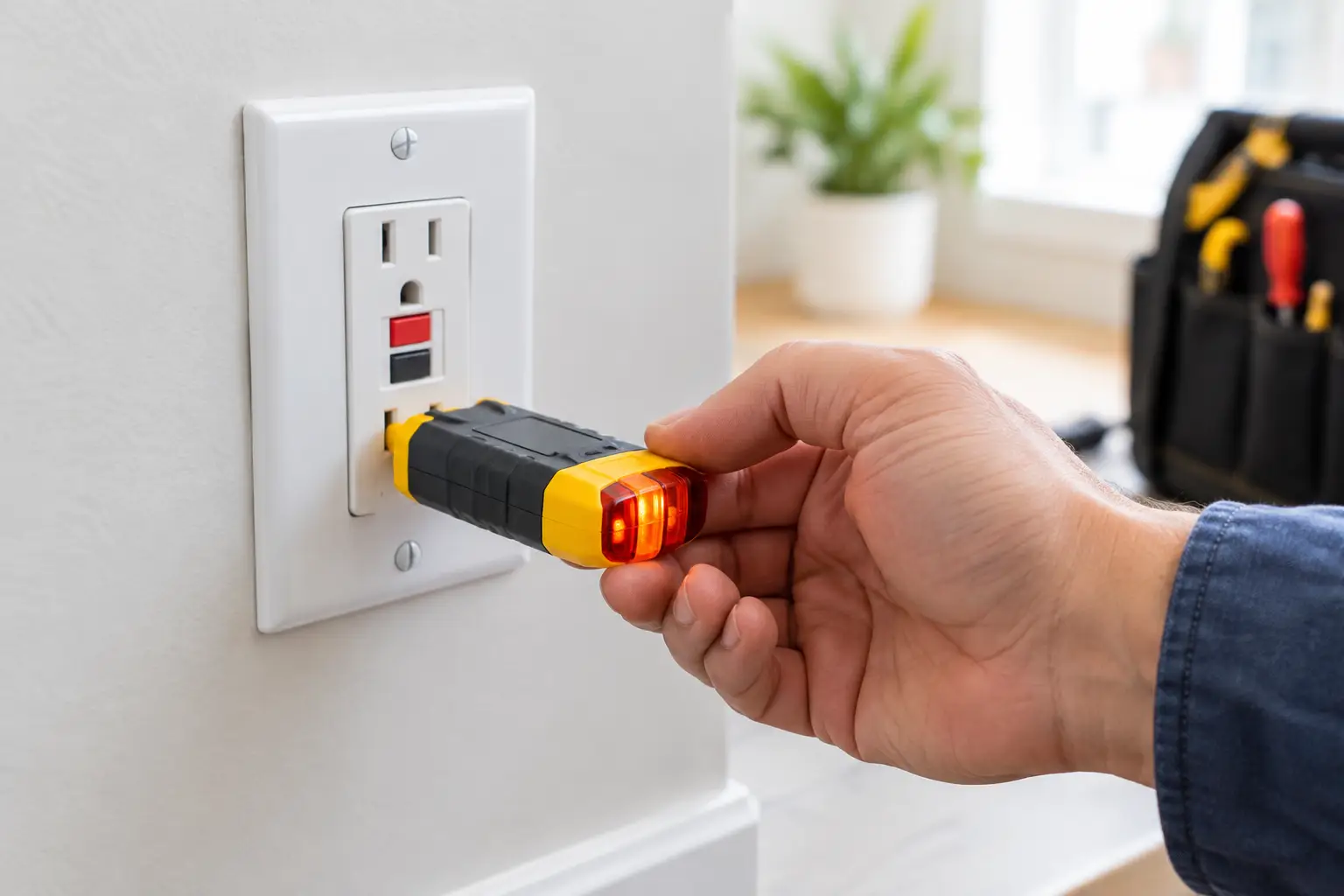
That outlet beside the bathroom sink has one job that matters more than convenience: it can cut power in a fraction of a second when it senses electricity going somewhere it should not. Knowing how to test GFCI outlets helps confirm that protection is working before a close call turns into a serious shock hazard.
GFCI stands for ground-fault circuit interrupter. These outlets are common near water, including bathrooms, kitchens, garages, laundry areas, basements, crawl spaces, exterior walls, and pool equipment. They look much like regular outlets, except they usually have two small buttons labeled TEST and RESET.
The check itself takes less than a minute. The key is knowing what a normal result looks like and when a failed test means you should stop using the outlet and call a qualified electrician.
Why GFCI outlets need regular testing
A GFCI does not wait for a circuit to overload. It monitors the electricity flowing out and back through the circuit. If it detects even a small difference, which can happen when current leaks through water or a person, it shuts off power quickly.
That makes GFCI protection especially valuable where wet hands, damp floors, appliances, and electrical cords can collide. A standard circuit breaker may protect wiring from overheating, but it is not designed to provide the same level of personal shock protection.
The catch is that a GFCI can appear normal while its protective mechanism is no longer functioning correctly. The outlet may still deliver power to a phone charger or hair dryer, but fail to trip during a ground fault. Regular testing is the simple way to catch that problem.
Many manufacturers recommend testing GFCI devices monthly. In a busy household, putting a recurring reminder on your phone is practical. At minimum, test them a few times a year and after a major electrical event, such as flooding, a lightning strike, or repeated breaker trips.
How to test GFCI outlets in three steps
Before you begin, make sure your hands are dry and the floor around the outlet is dry. Do not test an outlet that is cracked, loose, warm, buzzing, discolored, or visibly wet. Those are reasons to leave it alone and get professional help.
1. Plug in a small device or turn on the outlet's load
Use a lamp, night-light, or other simple device you know works. Plug it into the GFCI outlet and confirm it has power. A lamp is useful because you can immediately see whether it turns off.
Keep in mind that one GFCI outlet may protect several other outlets farther down the circuit. The outlet in a garage, bathroom, or basement may control another receptacle in a nearby room or even outside. If you are checking an outlet without TEST and RESET buttons that has no power, look for a tripped GFCI elsewhere before assuming the outlet itself has failed.
2. Press the TEST button
Press the button labeled TEST. You should hear or feel a click, and the lamp or device should turn off. The RESET button may pop outward.
This is the expected result. The outlet has interrupted power as designed.
If the device stays on after you press TEST, stop using that outlet. The GFCI may not be providing protection, or the outlet may be incorrectly wired. Do not rely on it near water just because it still supplies electricity.
3. Press RESET and confirm power returns
Press the RESET button firmly until it clicks into place. The lamp or device should turn back on.
If it resets and power returns, the basic test is complete. If the RESET button will not stay in, there may be a tripped circuit breaker, no power reaching the outlet, a wiring issue, moisture, or a failed GFCI device. Avoid forcing the button repeatedly. That will not solve the underlying problem.
What the results are telling you
A successful test is straightforward: TEST cuts the power, and RESET restores it. Anything else deserves a closer look.
If the TEST button will not trip the outlet, treat the outlet as unprotected. If the RESET button will not engage, check your electrical panel for a tripped breaker once. Switch the breaker fully off, then back on. If the GFCI still will not reset, leave it off and arrange an electrical inspection.
A GFCI that trips repeatedly is also sending useful information. Sometimes the cause is simple, such as a wet outdoor cover, a damp extension cord, or an appliance that developed a fault. Other times, the issue is in the circuit wiring, a connected outlet, or a device plugged in elsewhere on the same line.
The right response depends on what changed. If it trips after rain, moisture is a likely suspect. If it trips whenever one appliance is plugged in, unplug that appliance and do not use it until it is checked. If it trips with nothing connected, the circuit needs professional diagnosis.
GFCI outlet or GFCI breaker: know what you have
Not every GFCI-protected circuit has buttons at the outlet. Some homes use a GFCI breaker in the electrical panel instead. It typically has a TEST button on the breaker itself and may protect an entire circuit.
You can test a GFCI breaker by following the instructions printed on the panel and breaker, but use extra care around the electrical panel. The panel is not a place for exploratory repairs. You can press a clearly labeled TEST button, but do not remove the panel cover or touch internal wiring.
Newer homes may also have combination protection devices that include arc-fault protection. These devices can be more sensitive to electrical problems, and their trip behavior can be less obvious. If you are unsure which device controls an outlet, a licensed electrician can map the circuit and explain what is protected.
Common mistakes to avoid when testing GFCIs
The biggest mistake is assuming a RESET button means an outlet is safe. Reset only restores power. The TEST button verifies that the protective function can trip.
Another mistake is replacing a repeatedly tripping GFCI with a standard outlet. That removes a required layer of protection in locations where water exposure is more likely. It can also create code and insurance concerns, especially in a rental or managed property.
Avoid these risky shortcuts:
- Do not test an outlet with wet hands or while standing on a wet surface.
- Do not remove the outlet cover or pull the receptacle from the wall to investigate.
- Do not keep resetting a GFCI that trips immediately or feels warm.
- Do not use extension cords as a permanent workaround for a dead outlet.
For renters, report a nonworking GFCI to your landlord or property manager rather than attempting a replacement. For homeowners, replacement may look simple online, but correct line-and-load wiring matters. A miswired GFCI may deliver power without protecting downstream outlets.
When to call a trusted local electrician
A failed GFCI test is a good reason to call an electrician, but certain signs make the need more urgent. Turn off the circuit if you can do so safely and seek help if you notice a burning smell, scorch marks, buzzing, sparking, melting plastic, repeated trips, water inside an outlet box, or a shock or tingling sensation from an appliance or fixture.
You should also call a pro when multiple outlets lose power and you cannot identify a tripped GFCI or breaker, when an outdoor outlet stops working after rain, or when a RESET button refuses to stay in. These issues can involve hidden wiring, moisture intrusion, or a failing appliance. Guessing wastes time and can create a hazard.
If you can see the problem but cannot name it, take a clear photo. Ono-Fix can use that visible clue to help identify the issue and route you toward the right trusted local professional, without making you sort through electrical terminology first.
A GFCI test is small home maintenance with a big payoff. Take a minute to check the outlets near water, and let a qualified electrician handle anything that does not behave exactly as it should.